
You're advising on whether to pursue a local ballot measure. The client has a number in mind—maybe a parcel tax, maybe a bond—and wants to know if it can pass. The jurisdiction "feels" like it should be receptive.
Feelings aren't evidence. The evidence is in the Ideology Analysis section of the jurisdiction page: how this community has voted on similar measures in the past, broken down by category. Here's what that analysis looks like in practice, using Belvedere, California.
How this analysis is done
Navigate to any jurisdiction page in The Ballot Book and open the Ideology Analysis section, which shows how the community has voted on statewide propositions broken down by category—taxes, bonds, criminal justice, and more. The proposition-level detail reveals whether past voting patterns suggest structural support or resistance for a given measure type. Belvedere is used as an example; the same analysis works for any California jurisdiction.
The Situation
A small Marin County city is considering a real estate transfer tax to fund infrastructure improvements. The measure would require voters to also approve converting the city to a charter city. You're asked to assess viability before they commit to a campaign.
Belvedere is wealthy, educated, and—based on everything you've heard about Marin—presumably progressive. The assumption is that a measure for infrastructure and public safety should pass comfortably.
That assumption would cost someone a lot of money.
The Shortcut That Falls Short
The natural move is to look at the jurisdiction's overall political lean and extrapolate. Belvedere is in Marin County. It votes Democratic. It must support taxes and bonds, right?
This is the most expensive mistake in ballot measure consulting: assuming that partisan lean predicts fiscal behavior. It doesn't. A community can be progressive on criminal justice reform and conservative on tax increases. These are different dimensions, and the Ideology Analysis treats them that way.
What the Scores Said
Before November 2022, the Ideology Analysis for Belvedere showed a jurisdiction that doesn't fit a simple liberal-conservative axis:
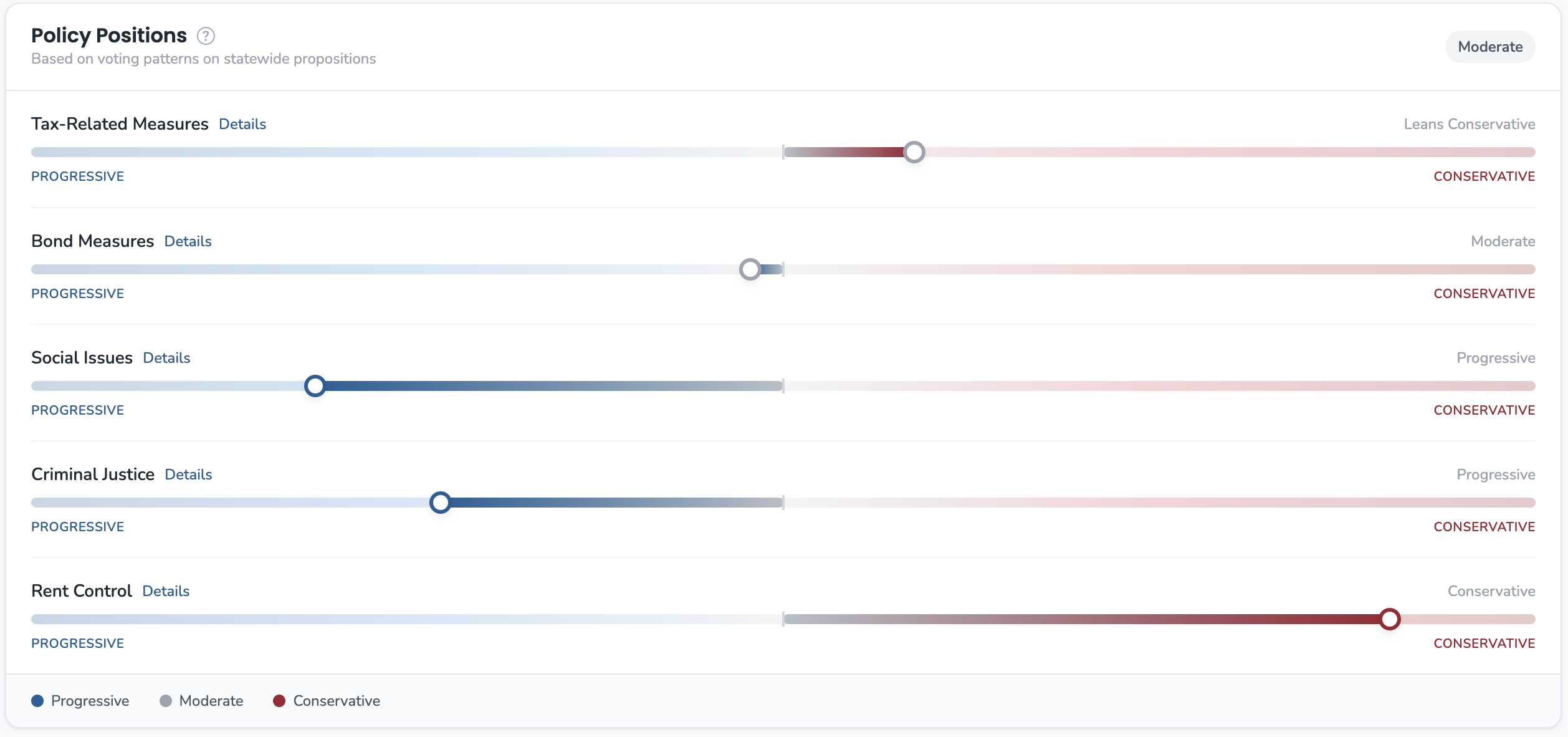
A 45-point gap between criminal justice and taxes. This is a community that votes to reform the justice system but hesitates to raise its own taxes. The percentile ranking means Belvedere votes more conservatively on tax measures than 57% of similar California jurisdictions.
"Progressive" here doesn't mean "will vote for anything."
What the Proposition History Showed
The category scores come from actual votes on statewide propositions. Before the 2022 election, Belvedere's voting record on revenue measures told a consistent story:
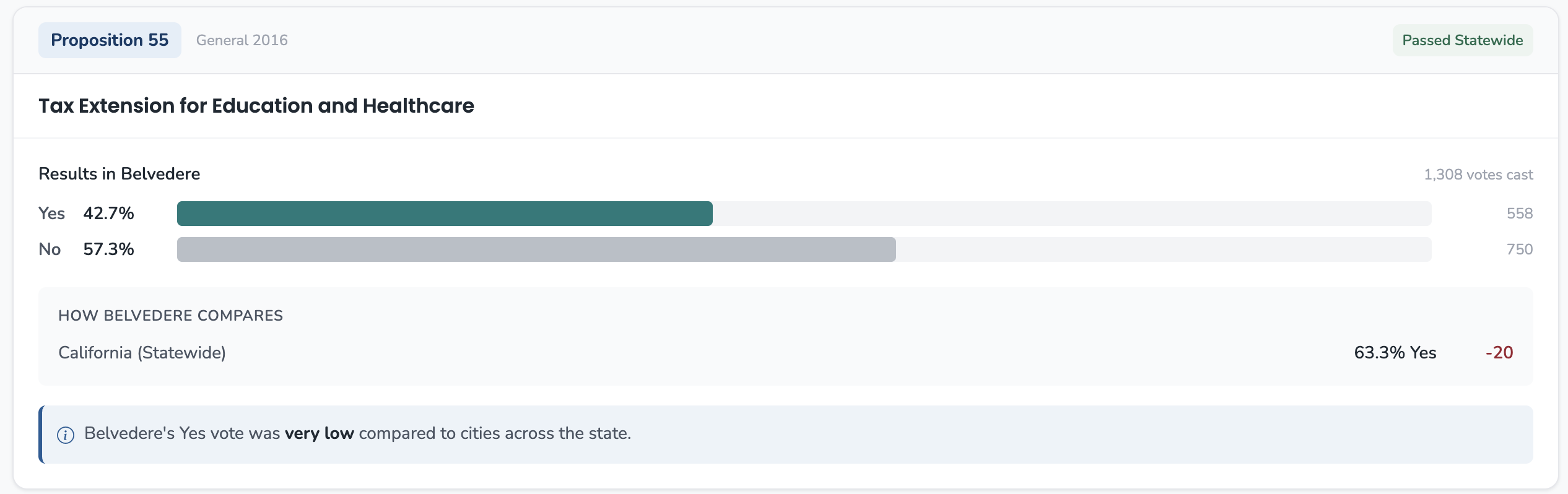
On Prop 55, Belvedere ranked in the bottom 6% of jurisdictions—and as a wealthy Marin enclave, many of those voters were likely the high earners who'd pay the tax. When the measure touched property (Props 15 and 19), support was middling at best.
This wasn't a community primed to embrace a new real estate transfer tax.
What Actually Happened
In November 2022, Belvedere put Measure D on the ballot: a charter city conversion paired with a real estate transfer tax of $8 per $1,000 on property sales. The revenue—estimated at $1.6 million annually—would fund public safety, earthquake infrastructure, fire suppression, and evacuation routes.
It failed 44% to 56%.
560 yes votes. 708 no votes. In a city of about 2,000 people, fewer than 1,300 bothered to vote on it, and those who did said no.
What Made It Predictable
The ideology scores weren't decorative—they were diagnostic. At the 43rd percentile for taxes, Belvedere ranks below the median of California jurisdictions on fiscal measures. That's not "moderate." That's a community where tax increases face structural headwinds before a single campaign dollar is spent.
The proposition-level data made the pattern specific. When Belvedere voted on Prop 55 at the 6th percentile—meaning 94% of similar jurisdictions were more supportive—that was a signal. A real estate transfer tax in a city where median home values exceed $3 million was asking residents to pay tens of thousands of dollars per transaction. The ideology data said this was a tough sell. The election confirmed it.
Where They Do Say Yes
The pattern isn't uniform opposition. Belvedere voters are selective. On certain statewide bonds before 2022, they ranked well above median:
- Prop 68 (2018) — parks and water bond: 66.6% yes (79th percentile)
- Prop 2 (2018) — mental health housing bond: 68.2% yes (75th percentile)
- Prop 1 (2018) — veterans housing bond: 58.1% yes (72nd percentile)
Parks, mental health, veterans—these passed comfortably. The difference between a 75th-percentile bond measure and a 43rd-percentile tax measure is the difference between a viable campaign and a waste of resources.
What You Can Actually Say
"Belvedere looks progressive if you're only checking social issues and criminal justice—78th and 88th percentiles. But on taxes they're 43rd percentile, and on bonds they're 47th. Below median for California.
The statewide proposition data is specific: they voted 6th percentile on Prop 55, which was an income tax on high earners—and in Belvedere, that likely meant themselves. When taxes touch their own wealth, this community resists.
A real estate transfer tax here faced structural headwinds. And in 2022, that's exactly what happened—Measure D failed 44 to 56. The ideology scores called it.
If you're advising on a future measure, the path isn't a general tax. It's a bond for something specific they care about—parks, schools, mental health. Those have cleared 70% here. Taxes haven't."
When This Isn't the Right Approach
Ideology scores predict tendencies, not certainties. A well-run campaign can move margins. A poorly-run campaign can lose in friendly territory. The scores tell you what you're working with, not what's guaranteed.
They're also backward-looking. A community that was conservative on taxes five years ago might have changed. New residents, new priorities, different context. The scores are a baseline, not a verdict.