
You have 5 minutes before a call about a jurisdiction you haven't looked at in a while. You don't need to be an expert, but you do need to know enough to not say anything wrong—and to handle the first follow-up question.
Everything below comes from a single place: the jurisdiction page. Registration, election results, ballot measure history, census context—it's all there, which means you can see where the numbers align and where they don't.
Here's what that looks like in practice, using Madera, California.
How this analysis is done
Open any jurisdiction page in The Ballot Book to see registration versus actual voting behavior, recent statewide race results, ideology scores broken down by issue category, and demographic composition. Layering these data points reveals where the numbers align and where they diverge. Every California jurisdiction in the platform follows this same structure.
The Situation
A lobbying firm has a client interested in a development project in Madera. The client wants to know the political landscape before deciding whether to engage. You're the analyst on the call. You've never worked in Madera and haven't thought about it in years.
If you open with a single number and no context, you're exposed the moment someone asks a follow-up. If you rely on stale assumptions—"Central Valley, heavily Latino, probably pretty Democratic"—you can get corrected by someone who actually knows the area.
The Shortcut That Falls Short
The natural move is to grab registration and hope it's enough.
For Madera, that number looks reassuring: D+11. A client might hear that and assume they're dealing with a reliably blue city.
That assumption would be wrong.
What Jumped Out
The first thing that doesn't fit is on the Summary page: the gap between registration and actual voting.
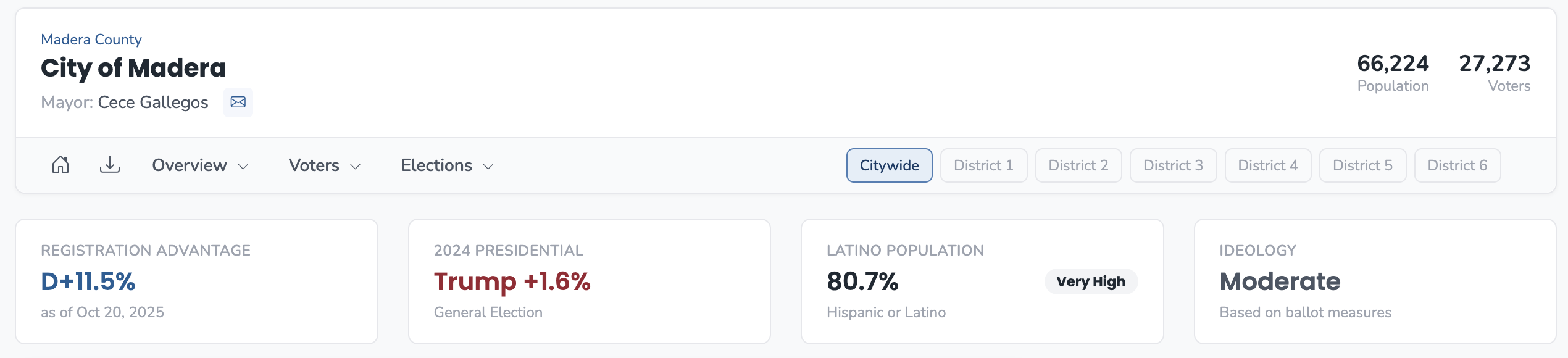
- Registration Advantage: D+11.5
- 2024 Presidential Result: R+1.6
Trump won Madera. A city that's D+11 by registration went Republican. That's a 13-point gap.
And it's not a one-off. The 2022 Governor race went R+5.5. The pattern is consistent.
What Made It Worse
Looking back one cycle in the Electoral History makes the shift hard to ignore.
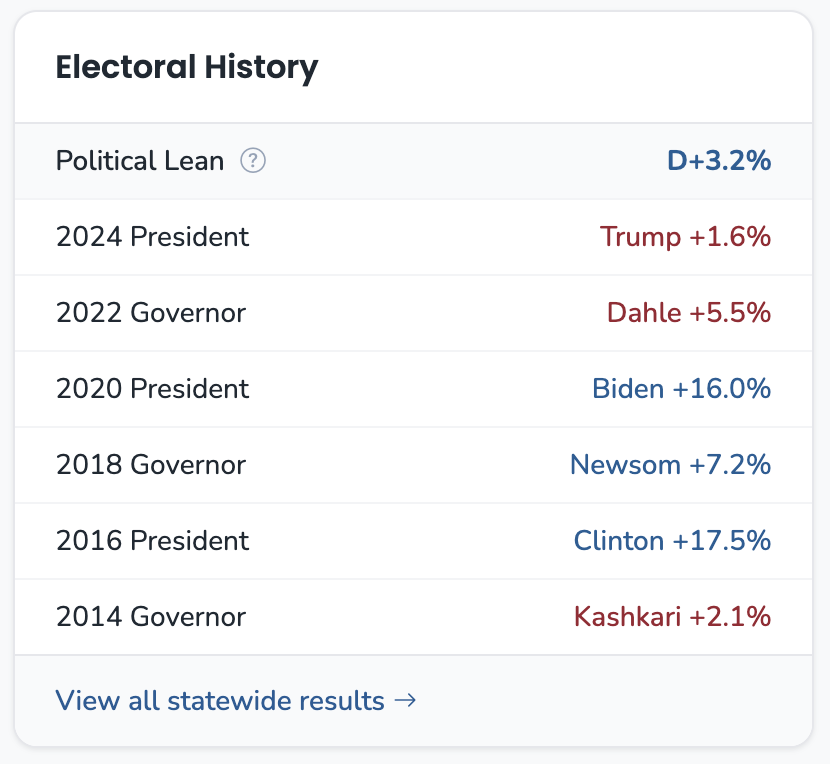
- 2020 Presidential: D+16.0 (Biden won)
- 2024 Presidential: R+1.6 (Trump won)
An 18-point swing in four years. Madera went from voting like its registration to voting against it. Registration stayed flat. Actual votes moved nearly 18 points toward Republicans.
What Explains It
The Ideology section is where it starts to make sense.
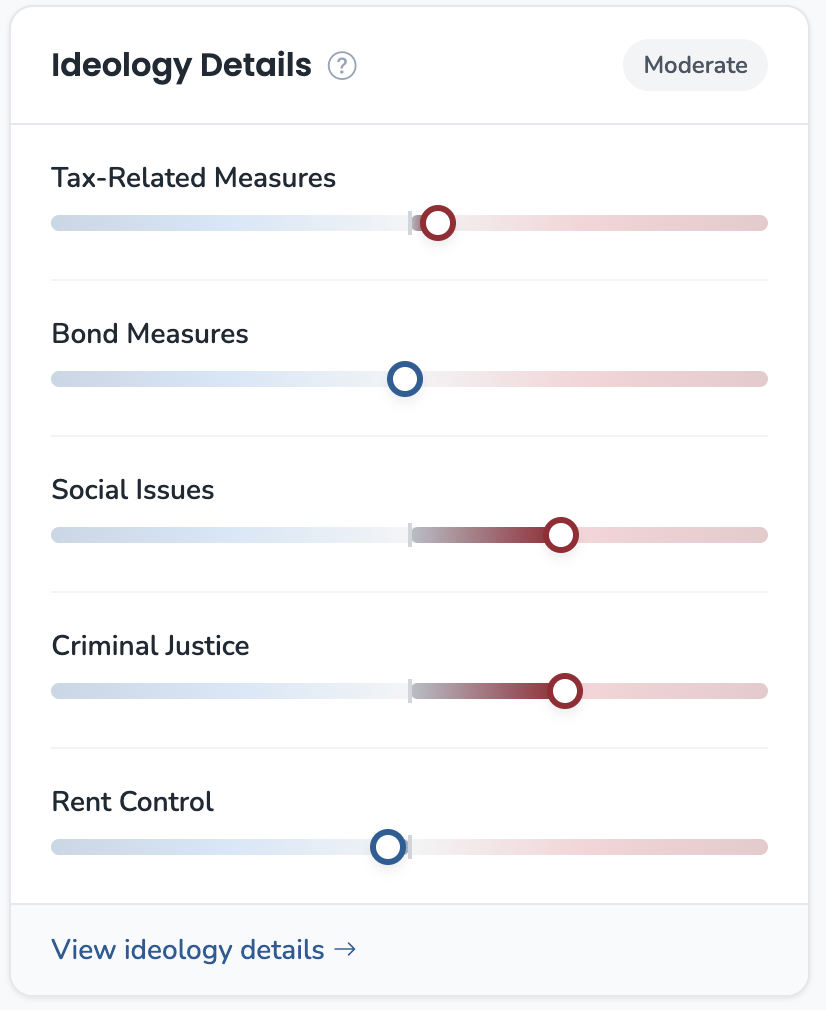
The bars show where Madera falls relative to other California jurisdictions. Blue is progressive, red is conservative. Madera is moderate on fiscal issues but notably conservative on social issues and criminal justice.
Cross-pressured: economically willing to spend, but culturally and socially conservative.
That's not a contradiction—it's a pattern.
What Ties It Together
The Community Profile shows Madera is over 80% Latino.
The Central Valley Latino vote has been shifting rightward, particularly on cultural and crime issues. Madera exemplifies this: voters who still register Democratic but increasingly vote Republican, especially in federal races.
The demographic composition that once made this area reliably Democratic now produces a very different voting pattern.
What You Can Actually Say
"Madera looks Democratic on paper—D+11 registration—but Trump won it in 2024 by about 2 points. That's a 13-point gap between registration and actual voting, and it's a recent shift: Biden won here by 16 points in 2020.
The ideology data explains part of it. Madera is moderate on taxes and bonds but conservative on criminal justice and social issues. It's a Central Valley pattern: economically pragmatic, but culturally conservative.
The city is over 80% Latino, and this fits the broader story of Latino voters in the Central Valley shifting rightward on cultural issues. If your client is thinking about a development project, the city council dynamics here probably don't track with the registration numbers. I'd want to look at recent local races before assuming anything about who holds power."
You've layered registration, voting behavior, ideology, and demographics. You can handle a follow-up. And you've flagged what you'd still need to check.
When This Isn't the Right Approach
If the person across the table knows Madera better than you do, the goal isn't to assert conclusions—it's to ask better questions. And if the conversation is narrowly about a single parcel or one city council race, this kind of sweep isn't what's needed.
This is for moments when you need orientation, not authority.